Lawyer Zhu Debao: Addressing the Challenges of AI-Generated Content (AIGC) with Professionalism
——Taking ChatGPT as an Example
Zhu Debao, Director, Doctor,
Shanghai Xinyi Law Firm
According to the latest reports, a judge in Colombia used ChatGPT in handling a medical rights case involving a child with Autism Spectrum Disorder (ASD) to verify relevant information in the case and determine whether the boy was eligible for exemption from medical expenses. This marks the first public application of ChatGPT — the recently popular AI-Generated Content (AIGC) software — in the legal field.
Colombia’s Law No. 2213, enacted in 2022, stipulates that judges may occasionally use AI software to assist in making rulings. In this case, ChatGPT interpreted the provisions on medical expense exemptions for autistic individuals in accordance with Colombia’s Law No. 1753 of 2015. Through only a few conversations, the judge completed the relevant work with ChatGPT, saving time in advancing the litigation process and facilitating the drafting of legal documents. Ultimately, ChatGPT also supported the judge’s ruling: the child’s medical expenses would be covered by the medical insurance system, and the family would not be liable for medical costs including transportation expenses.
Although the final ruling faced no objections and the judge emphasized that the purpose of AI-generated text is not to replace judicial decisions but to save time in document drafting, the judge’s use of AI software in the case still sparked considerable controversy. AI ethicists argue that while ChatGPT’s application in this court ruling was primarily to accelerate the litigation process and its responses were fact-checked, AI software often performs poorly in addressing certain stereotypes, may exacerbate existing forms of inequality, and its responses may be inaccurate, imprecise, or even false — all of which could negatively impact judges’ decisions. However, Colombia’s Supreme Court expressed support for the practice, stating that the judicial system should fully leverage technologies such as AI as powerful tools to assist judges in enhancing their decision-making capabilities.
In 2015, Sam Altman co-founded OpenAI, a non-profit artificial intelligence company based in San Francisco, with Elon Musk, CEO of Tesla. At its establishment, the company secured a committed investment of $1 billion from several Silicon Valley tycoons, including the founder of LinkedIn, with the mission of researching AI that would not pose a threat to humanity.
In November 2022, the ChatGPT chatbot was launched. It can independently learn from data and generate complex outputs through large-scale data training. ChatGPT has attracted a growing number of users through its free and user-friendly access. According to relevant research reports, ChatGPT recorded 13 million daily active unique visitors in January this year — more than double the figure in December last year — and reached 100 million monthly active users (MAU) in the same month. From its launch to achieving this MAU milestone, Instagram took two and a half years, the previously popular TikTok took nine months, while ChatGPT accomplished it in just two months, making it the fastest-growing consumer-facing app in history.
As early as 2019, when OpenAI transitioned to a for-profit model, it received a $1 billion investment from Microsoft. Recently, Microsoft is considering an additional investment of $10 billion and aims to integrate ChatGPT into multiple services such as its Office suite, Bing search, and cloud services. Bill Gates even stated explicitly that the birth of ChatGPT is comparable in significance to the advent of personal computers and the Internet.
However, as mentioned earlier, while ChatGPT’s remarkable capabilities have excited the market and academic circles, they have also inevitably raised concerns. In the long run, ChatGPT’s ability to generate AI content will have a profound impact on the work methods of researchers and service industry professionals.
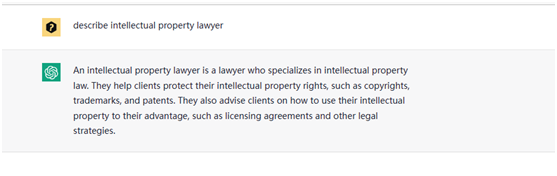
Figure:ChatGPT's Description of Intellectual Property Lawyers
First and foremost, it must be clarified that ChatGPT will undoubtedly exert an impact on the legal profession.
Some scholars have predicted that by 2045, 50% of human jobs will be replaced by AI and automation technologies—a trend that has become inevitable. In just a few months, ChatGPT has demonstrated exceptional performance across diverse fields, including technical writing, content creation, statistical analysis, advertising creativity, graphic design, news editing, image trading, and entry-level programming. A professor at Northern Michigan University in the United States discovered that an "A+ paper" submitted by one of his students at the end of the semester—hailed as "the best in the class" for its rigorous logic, appropriate examples, and concise writing—was actually written by ChatGPT. This has prompted many American universities to take precautions against such academic misconduct among students.
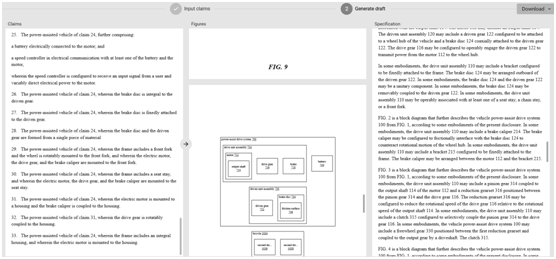
Figure: Patent Drafting and Drawings Automatically Generated by PatentPal Based on Claims
Such highly disruptive AI software has also dealt a significant blow to lawyers. Legal professionals like lawyers typically absorb and process vast amounts of information, then apply their professional knowledge to judge or discuss relevant issues, ultimately producing standardized documents or opinions. Obviously, these language-oriented professional activities often follow fixed structures. After extensive training, AI—focused on language and text—can fully meet the demands of certain positions, and may even perform more efficiently than humans. Therefore, AI tools like ChatGPT pose a substantial threat to the legal profession.
To this question, we must cautiously answer: "Not yet."
As products of AI trained on big data, AI-generated content currently only provides assistance limited to relatively structured tasks. However, the widespread application of AI-generated content is undoubtedly inevitable. It can help us reduce errors, avoid biases, and serve as a powerful tool to boost productivity—clearly, we cannot fully prohibit the development of such technologies.
Despite witnessing ChatGPT’s impressive performance, we have also seen cases where AI-generated content deviates significantly from expected results, as well as issues like the proliferation of low-quality information. In severe cases, this could distort scientific knowledge and spread misinformation, making it impossible for us to fully trust AI. Additionally, the inevitable voice recording during AI’s participation in court proceedings may violate court rules that prohibit recording in some jurisdictions.
The same applies to the legal profession. While we may rely on AI for tasks like legal research (as seen in the Colombian judge’s use of ChatGPT to analyze statutory provisions), judges still need to verify the accuracy of AI-generated content to avoid mistakes. Moreover, a crucial aspect of legal work involves emotional judgment—understanding the needs of clients or employers. Currently, AI cannot meet the requirements for judging human values and emotions. At this stage, we can only and must regard AI as a tool to enhance productivity, not a replacement.
ChatGPT’s impact on lawyers and other legal professionals is already evident and will not diminish, but this influence will develop gradually. Clients and the public also need time to accept it.
While ChatGPT cannot replace all lawyers at present, some professionals already feel the approaching crisis.
AI technologies like ChatGPT pose the greatest threat to knowledge workers. AI can efficiently read, understand, integrate, and write based on large volumes of textual data—some media outlets have already started using AI to write articles. This challenge can be extended to general practice lawyers: in terms of mastering legal provisions, conducting legal research, and drafting simple legal opinions, ChatGPT is already comparable to general practice lawyers. Although it may have flaws and inaccuracies in certain knowledge areas, these can be easily improved.
According to reports, a London law firm used the AI software Luminance to analyze over 10,000 documents related to a complex murder case. The AI completed the task four weeks faster than ordinary lawyers, saving over £50,000. Clearly, for general practice lawyers lacking specialized expertise, systematically trained AI tools like ChatGPT and Luminance will be more attractive to employers and clients, and thus exert the greatest impact on this group.
As mentioned earlier, AI technologies like ChatGPT have been and will be increasingly widely applied in the legal field. So, how should lawyers respond to this challenge? In the author’s opinion, the most important approach is to pursue specialized development.
Faced with the rapid rise of ChatGPT, we may worry that professionals in fields like pleading drafting, trademark applications, and patent filings will face a difficult and financially painful period—prompting the cry "The wolf is here!" However, the law is complex. Beyond statutory provisions and case analysis, it involves various intricate scenarios. Only lawyers with strong diversified and interdisciplinary capabilities, supported by excellent professional expertise, can gain recognition from more clients, resolve complex cases through their skills, and earn greater respect.
In today’s era of ongoing AI disruption, employers and clients have higher requirements for lawyers’ professional competence and stronger ability to distinguish between qualified and unqualified services. The core competitiveness of individual lawyers and teams is increasingly reflected in their level of specialization. To achieve absolute professionalism, lawyers must continuously invest in acquiring specialized knowledge, strengthen their role in social and legal work, and focus on creating genuine value for clients as the ultimate goal.
While ChatGPT undoubtedly poses a challenge to lawyers, specialized lawyers can better meet client needs when facing this disruption. Through the unique human emotional connection, they can communicate deeply with clients and develop more tailored legal solutions.
China has launched multiple AI-assisted products in the judicial sector. The Supreme People’s Court even issued the Opinions on Regulating and Strengthening the Judicial Application of Artificial Intelligence last year, proposing to basically establish a relatively complete system for the judicial application of AI technology by 2025, and build a leading and exemplary system for the application and theory of judicial AI by 2030. Clearly, an AI technology storm has already swept through the judicial field.
In response to news about ChatGPT, some commentators have stated, "Programmers are being replaced by the programs they wrote." However, we must emphasize that AI technology continues to evolve through constant iteration and upgrading. It is not programmers’ own programs that are taking their jobs, but those with higher capabilities replacing those with lower capabilities. This is a normal social phenomenon—improved efficiency inevitably leads to the elimination of underperformers, which applies to all industries.
As lawyers facing career challenges brought by AI, we must pursue specialized development. Although this process may require us to give up certain things, this growing pain will be rewarded with overall growth in our professional careers. We will face challenges with greater confidence and market competitiveness, and be able to smile calmly in the face of AI technology.

